The Battle Belongs to the Lord

Scripture Reading: Psalm 44:4-8
At prayer meeting this week I asked the question, “Of all the disciples, who do you think is the most relatable to people today?” I mentioned that I thought it was Peter, and the head nods in the pews confirmed that most people would agree with that. Why is Peter so relatable to us? Because more than any other disciple, we see his weaknesses. Peter was so eager to be such a devoted follower of Jesus, that his over-eagerness often caused him to stumble.
Think about when Jesus calls Peter to walk on the water with him. At first things are great, but then down he goes, in need of rescue. Perhaps the most famous of Peter’s battles came in the courtyard of the high priest on the night Jesus was arrested. Three times people accused Peter of being a follower of Jesus, and three times Peter denied knowing the Lord, showing us that even the most devout Christians can sometimes let the fear of man get the best of them.
Each and every one of us have spiritual battles that we must face. Sometimes these battles present themselves as difficulties with faith or struggles with doubt; sometimes they come as health issues either with ourselves or our loved ones; and sometimes they show up as parenting challenges, financial challenges, or a host of other challenges. Spiritual battles are real and they affect all of us. The question that we’ll try to answer today is, “How do we seek the Lord in the midst of a spiritual battle?”
Psalm 44 is a lament to the Lord in the middle of a great defeat, and a cry for Him to rescue His people, but in the middle of it, in verses 4-8, we find a beautiful pattern for seeking the Lord.
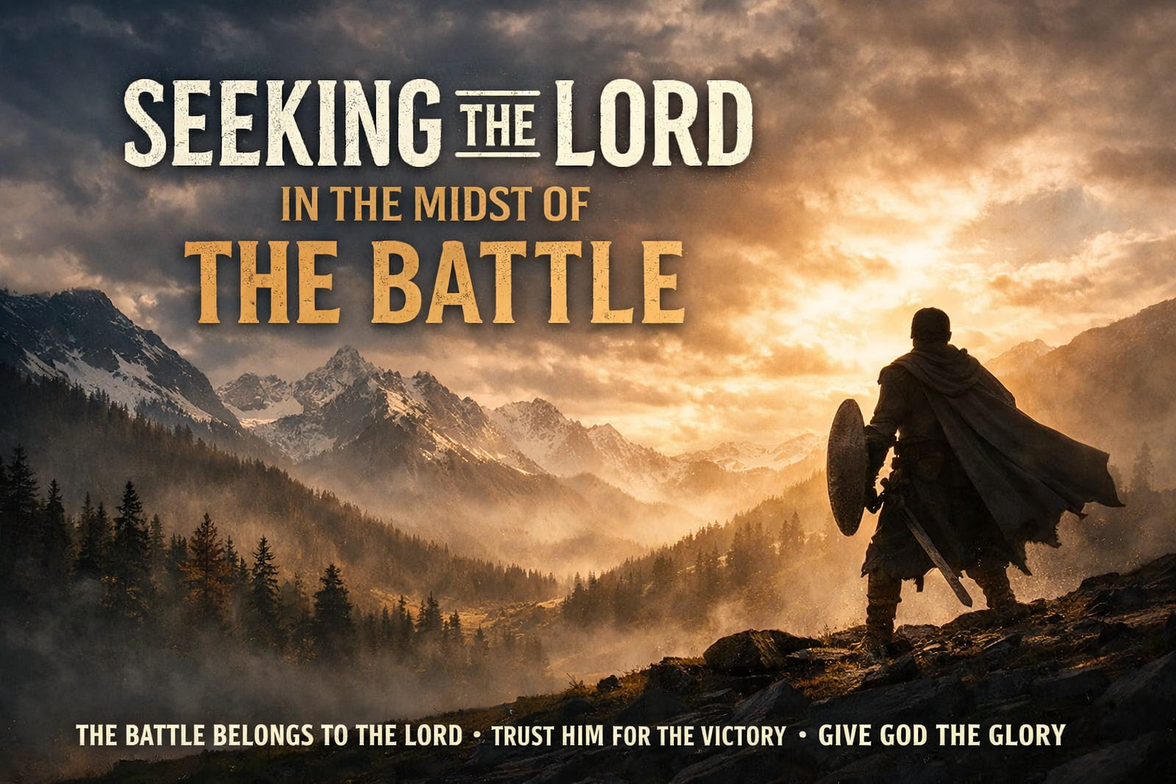
In verses 4-6, we see the Psalmist acknowledging that the battle belongs to the Lord. He says that it is GOD who ordains the victory. We must remember that as Christians, God has assured us that our strength does not come from ourselves, but it comes from HIM! (Eph. 6:10, Psalm 121). The problem that we run into in the middle of our battles is that we often listen to our flesh. It asks questions like “How can I fix this? What must I do in this situation? How can I get out of this?” Instead, we need to be surrendering to the Holy Spirit that lives inside us and whispers “The Lord will guide you and carry you through this battle, He will fight for you.” We see this struggle in Peter’s life too. As soon as he focused on what was around him and His situation instead of focusing on the Lord and keeping his eyes on Christ, that’s when he fell, and that’s when we see his failures on full display. It's important to remember that the battle belongs to the Lord.
Secondly, we must trust the Lord for victory in the battle. Verses 6 and 7 remind us of this as the psalmist says it’s not his bow or sword that he trusts, but the Lord that gives him the victory. Why do we have such a hard time trusting the Lord when the heat is on? Perhaps it’s our constant need to be in control of our situation. We don’t like to give up control. God knows this, and that’s why He tells us over and over to trust Him, and that His ways are better than our ways. (Prov. 3:5-6, 2 Cor. 5:7, Isaiah 55:8-9). Trusting the Lord is difficult, but it’s always the right decision, especially in the middle of our spiritual battles.
Finally, it’s important that we remember to give God the glory in the end. In verse 8 the psalmist boasts not in himself, but in the Lord, giving Him praise forever. If God is the one who fights for us, and sees us through our battles, then why should we get any of the credit? Remembering His goodness, faithfulness and mercy in the battles today, will help us to remember to turn to Him and trust Him in the battles that lie ahead.
I’m so thankful that we serve a God who desires to be a part of our lives, and doesn’t leave us on our own in our battles. He has been with us in the past, He is with us today, and will be with us forever. When we put our faith in Jesus, we don’t have to wait to have life with Him until we get to heaven! He is with us today, and will be with us throughout all eternity! Glory to His Name!
For further study, read 2 Chronicles 20:1-30 and see how King Jehoshaphat followed these three steps when the Moabites, Ammonites, and Meunites came to fight against him.

-
Location